
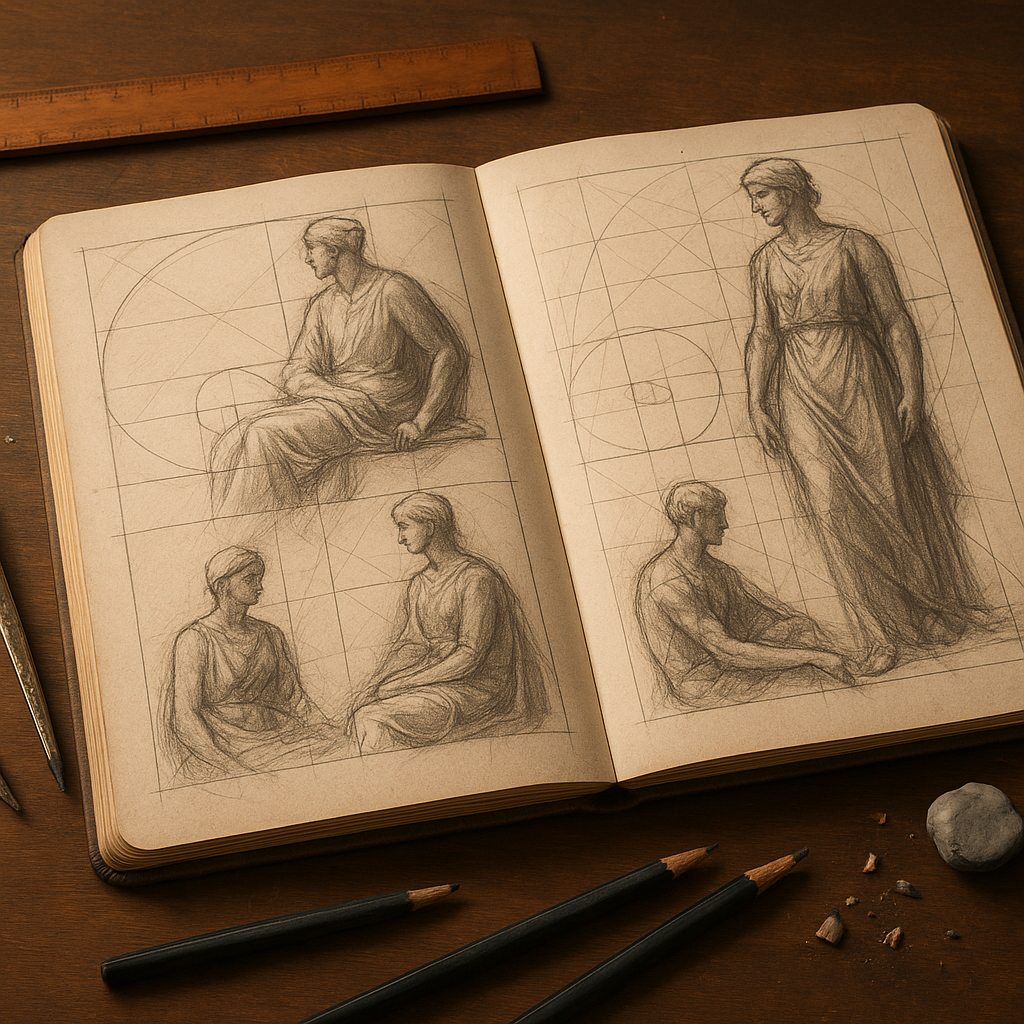
Walk into any museum and stand in front of a Renaissance masterpiece. Before you can identify a single brushstroke or name the subject matter, something pulls your eye in a specific direction. You feel a sense of order, tension, or calm — often without knowing why. That invisible architecture holding everything together? That’s composition at work.
Classical drawing artists didn’t leave this to chance. From Leonardo da Vinci mapping out geometric grids beneath his figures to Albrecht Dürer studying proportion and balance obsessively, composition was treated as a discipline — a set of principles as learnable as perspective or anatomy. These weren’t rigid rules to follow blindly, but deeply understood frameworks that gave artists the power to guide a viewer’s experience with intention.
This article breaks down the composition principles that classical drawing artists actually studied and applied — not vague advice, but practical, visual strategies you can start observing and using right away.
Why Composition Was Central to Classical Drawing Practice
Before photography, before digital tools, classical artists were responsible for every visual decision on the page or canvas. Composition wasn’t a finishing touch — it was the first decision made. Many classical masters would spend weeks on compositional studies, producing dozens of thumbnail sketches before ever committing a final line.
The word “composition” comes from the Latin compositio, meaning “putting together.” In classical drawing, this meant organizing lines, forms, values, and space in a way that created a unified, purposeful image. According to art historians, Renaissance artists like Raphael treated compositional planning as the intellectual core of their process — the part that distinguished a craftsman from an artist.
What’s remarkable is how consistent these principles are across centuries and cultures. Whether you study European Academic drawing from the 19th century or the compositional structures of East Asian ink painting, the same fundamental ideas appear again and again.
The Core Composition Principles Classical Artists Relied On
The Rule of Thirds and Its Classical Roots
Most modern creatives are familiar with the rule of thirds — dividing an image into a 3×3 grid and placing key elements along the lines or at their intersections. But this principle has roots far older than the 18th-century writings where it was first formally named.
Classical artists instinctively understood that centering a focal point creates static, unengaging images. By placing the primary subject slightly off-center — what Renaissance painters did intuitively through years of training — they introduced visual tension that keeps the eye moving rather than settling. Raphael’s The School of Athens is a perfect example: despite its grand symmetry, the two central figures (Plato and Aristotle) are positioned with deliberate asymmetrical weight that guides the viewer’s gaze through the entire scene.
Triangular Composition
One of the most enduring classical composition structures is the triangle. Artists from da Vinci to Rubens used triangular arrangements to create stability and visual coherence, especially in multi-figure compositions.
The triangle works because the human eye naturally travels along its edges, creating a circular viewing path that keeps attention within the picture plane. Da Vinci’s The Virgin of the Rocks is a textbook example — the four figures form a clear pyramidal triangle, grounding the composition while directing movement upward toward the implied apex. It creates a sense of both rest and elevation simultaneously.
Classical artists used several triangle variations:
- Equilateral triangle — creates balance and formality, often used in religious or ceremonial subjects
- Inverted triangle — introduces tension and instability, useful for dramatic scenes
- Diagonal triangle — adds dynamic energy and movement to a composition
The Golden Ratio and Divine Proportion
Few concepts have captured the imagination of artists and mathematicians alike quite like the Golden Ratio — approximately 1:1.618. Classical artists, particularly during the Renaissance, were deeply influenced by the idea that this proportion appeared throughout nature and could be used to create inherently harmonious compositions.
Luca Pacioli’s 1509 text De Divina Proportione, illustrated by da Vinci himself, brought this concept into direct conversation with artistic practice. The Golden Spiral — a logarithmic spiral derived from the Golden Ratio — was used as a compositional guide to direct the flow of an image toward its focal point in an organic, satisfying way.

It’s worth noting that contemporary art historians debate how deliberately many classical artists applied the Golden Ratio versus how much was intuitive. Either way, understanding the principle helps modern artists recognize and recreate the kind of proportional harmony that makes classical drawings feel effortlessly balanced.
Visual Flow and the S-Curve
Classical artists understood that the eye doesn’t look at an image all at once — it travels. Composition is, in large part, about choreographing that journey. One of the most elegant tools for this is the S-curve, also known as the “line of beauty,” a term coined by the 18th-century artist William Hogarth.
Long before Hogarth named it, classical masters used S-curves instinctively. The serpentine line appears in figure poses, landscape arrangements, and the implied pathways between grouped objects. It creates a sense of grace and natural movement, drawing the viewer’s eye through the composition without abrupt stops or jarring redirections.
Baroque artists like Rubens took this even further, building entire large-scale compositions around flowing diagonal and serpentine movements that swept across massive canvases.
What Are the 7 Principles of Composition in Art?
This is one of the most common questions students ask when diving into compositional theory. While different educators organize these principles differently, the following seven are most consistently referenced across classical and academic art instruction:
- Balance — distributing visual weight evenly (symmetrically or asymmetrically) to create stability
- Unity — ensuring all elements feel like they belong to the same visual family
- Contrast — using differences in value, size, or texture to create visual interest and hierarchy
- Emphasis — directing the viewer’s attention to the most important element of the composition
- Movement — guiding the eye through the image using line, shape, and tonal pathways
- Rhythm — creating a sense of visual repetition or pattern that gives the image energy
- Proportion — the relationship between sizes of different elements within the composition
Classical artists didn’t necessarily memorize a numbered list like this — but all seven of these principles are observable in how they constructed their drawings and paintings. Academic training in the 19th century formalized many of these ideas into teachable frameworks.
Negative Space: The Overlooked Compositional Tool
One thing that separates genuinely skilled compositional thinkers from beginners is how they treat negative space — the areas of a drawing not occupied by the main subject. Classical artists understood that empty space is never truly empty. It has shape, weight, and communicative power.
Albrecht Dürer’s engravings demonstrate masterful control of negative space. The white areas in his work aren’t voids — they’re active shapes that balance the density of his intricate linework. The push-and-pull between positive form and negative space creates a visual tension that keeps the eye engaged throughout.
In practice, classical artists would often check their compositions by flipping them upside down or viewing them in a mirror — tricks still used today — to evaluate the abstract shapes of the negative space without being distracted by recognizable subject matter.
Value Structure as a Compositional Foundation
Beyond line and form, classical artists were highly attentive to value — the range of lights and darks within a composition. Before adding detail, many would work out a value structure through a process called “notan,” a Japanese concept meaning light-dark harmony, which was widely studied in Western academic drawing circles by the late 1800s.
The idea is simple but powerful: if you reduce your composition to just two values (pure black and pure white), does it still hold together as a strong, readable design? The greatest classical compositions pass this test. Rembrandt’s drawings, for example, often have a dramatic tonal structure that communicates mood and focus even when reproduced as simple black-and-white thumbnails.
A strong value structure does several things at once:

- It creates emphasis by making the focal point the area of highest contrast
- It groups elements together, preventing a fractured, scattered composition
- It establishes mood — high-key compositions feel airy and optimistic; low-key compositions feel weighty and dramatic
- It guides the eye naturally toward light areas first
The Role of Edges and Framing
Classical artists were meticulous about how their compositions related to the edges of the picture plane. Where a figure or object intersects with the border of the image is never accidental. Awkward tangents — where the edge of a form just barely touches the picture border — were considered compositional errors to be consciously avoided.
Framing devices were also commonly employed. Trees, architectural arches, or secondary figures were arranged to create a visual frame within the frame, concentrating attention on the central subject. This technique, visible in countless Dutch Golden Age paintings and classical figure studies, gives the viewer a sense of looking through a window rather than at a flat surface.
Learning to See Composition in Classical Works
The most effective way to internalize these principles isn’t through memorization — it’s through active observation. Classical artists trained by copying master works precisely because this process forced them to understand compositional decisions from the inside out.
A useful exercise is to take any well-known classical drawing and trace its major compositional elements with a pencil on tracing paper: identify the triangles, map the S-curves, note where value contrast is highest, and observe how the negative spaces are shaped. This analytical approach reveals the invisible structure that holds the image together.
Look for these specific elements when studying classical compositions:
- The implied geometric shapes formed by groups of figures or objects
- The direction implied by hands, gazes, and limbs — often used to redirect the viewer’s eye
- The placement of the lightest light and darkest dark, and how they relate to the focal point
- How the composition would read as a simple two-value notan sketch
Bringing Classical Composition Principles Into Contemporary Drawing
These principles aren’t museum artifacts. They’re as relevant to a contemporary illustrator, portrait artist, or urban sketcher as they were to a 17th-century Flemish master. The underlying visual psychology hasn’t changed — humans still process images with the same perceptual tendencies.
The key is moving beyond mechanical application toward genuine understanding. The rule of thirds is a starting point, not a formula. Triangular composition is a tendency to explore, not a template to trace. Classical artists used these principles as a language — once fluent, they could bend the rules deliberately, knowing exactly what effect doing so would produce. Part of that fluency comes from developing your own artistic voice, learning when to lean on structure and when to push against it.
That level of compositional fluency takes time and sustained observation, but it begins with the same first step every classical master took: slowing down, looking carefully, and asking not just what to draw, but where and why.
Conclusion
Composition in classical drawing isn’t about following a checklist — it’s about developing a visual intelligence that operates beneath the surface of every mark made. The principles covered here — triangular structure, the Golden Ratio, S-curves, value hierarchy, negative space, and edge relationships — aren’t arbitrary conventions. They reflect how human vision works and how art can guide experience.
Classical artists invested enormous energy in understanding these frameworks because they recognized that technical skill alone doesn’t create a compelling image. Structure does. Intention does. The drawing that commands attention across a crowded gallery wall is rarely the most technically polished — it’s the one with the strongest compositional backbone.
Whether you’re just beginning to study drawing or returning to fundamentals after years of practice, revisiting these classical principles offers a reliable foundation for making images that don’t just represent the world, but organize it in a way the eye finds genuinely satisfying.
