
Choosing the right watercolor paper can make or break a painting — and that’s not an exaggeration. Experienced watercolorists will tell you that even the most skilled technique falls apart on the wrong surface. Paper affects how paint spreads, how long it stays wet, how colors dry, and whether the final piece has that luminous quality watercolor is known for. Yet for beginners, the sheer number of options can be overwhelming.
This guide breaks down the different types of watercolor paper by texture, weight, and composition, and explains how each one actually performs in practice. Whether you’re just starting out or looking to refine your material choices, understanding what’s under your brush is just as important as what’s on it.
The Three Main Types of Watercolor Paper (By Surface Texture)
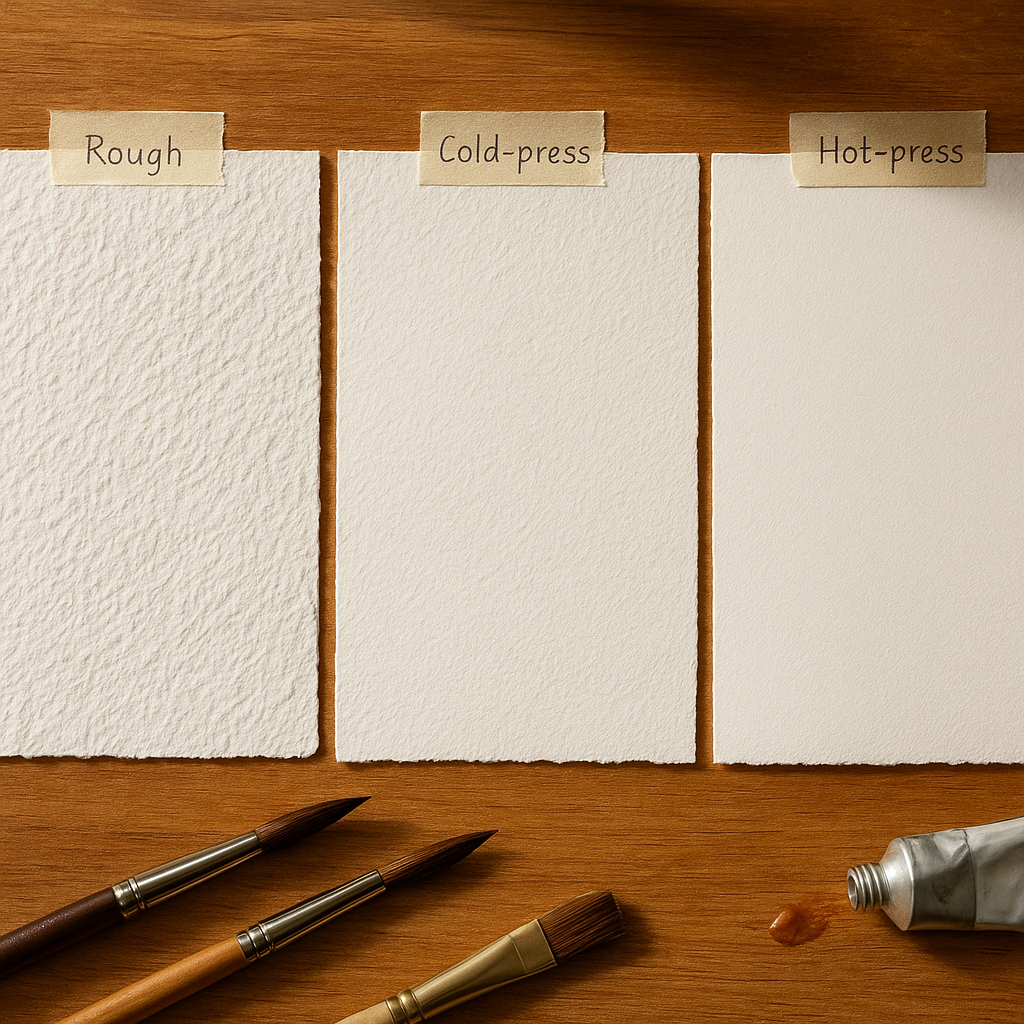
When people ask what are the three main types of watercolor paper, the answer comes down to surface texture. These three finishes — Hot Press, Cold Press, and Rough — are the foundation of how watercolor paper is categorized, and each produces distinctly different results.
Hot Press Watercolor Paper
Hot press paper is made by pressing the paper through heated rollers during manufacturing, which results in a very smooth, almost slick surface. There’s minimal texture or “tooth” to it, which changes everything about how paint behaves.
On hot press, watercolor paint tends to sit on the surface longer before being absorbed. This gives artists more time to manipulate wet paint, create crisp edges, and achieve fine detail. It’s a popular choice for botanical illustration, urban sketching, and detailed architectural work — any subject where sharp lines matter.
That said, hot press can be unforgiving. Brush strokes show more clearly, and certain techniques like wet-on-wet can produce unpredictable blooms if you’re not careful. Some artists find the smooth surface feels slippery, making it harder to control washes. It rewards patience and a more deliberate painting approach.
Cold Press Watercolor Paper
Cold press is the most widely used watercolor surface, and for good reason. It’s pressed with cold rollers through textured felts, leaving a slight but consistent tooth — enough to hold paint well, but not so much that it interrupts smooth washes.
This moderate texture strikes a balance between control and expressiveness. Washes flow evenly, granulating pigments settle beautifully into the small indentations, and the surface handles a wide range of techniques — glazing, lifting, wet-on-wet, and dry brush all work well. For most subjects, from loose landscapes to portrait studies, cold press is the go-to choice.
It’s also the most forgiving option for beginners. The texture helps disguise minor inconsistencies in brushwork, and the surface is more predictable than hot press when learning to control water.
Rough Watercolor Paper
Rough paper has the most pronounced texture of the three. It’s typically air-dried or dried with minimal pressing, leaving a heavily irregular surface with prominent peaks and valleys. When a lightly loaded brush drags across rough paper, the paint catches only the raised areas — a technique known as dry brush — creating a sparkling, broken texture that’s almost impossible to replicate on smoother surfaces.
Rough paper is beloved for expressive, gestural work: seascapes, dramatic skies, stone walls, and foliage. The texture does a lot of the visual work for you. However, fine detail becomes difficult, and some artists find rough paper fights against controlled washes. It’s less beginner-friendly, but in the right hands, it produces some of the most dramatic watercolor effects possible.
Understanding Watercolor Paper Weight
Beyond texture, weight is arguably the most practical consideration when choosing watercolor paper. Paper weight is measured either in pounds (lb) per ream or grams per square meter (gsm), and the two systems are used interchangeably across different brands.
What Is the Difference Between 140 lb and 300 lb Watercolor Paper?
This is one of the most common questions among watercolorists, and the difference is significant. 140 lb (300 gsm) paper is the standard for most watercolor work. It’s thick enough for regular painting but will warp and buckle when saturated with water unless it’s been stretched or pre-soaked first. Many artists use watercolor tape or a soaking method to prevent this.
300 lb (638 gsm) paper is much heavier and stiffer — closer in feel to a thin board than traditional paper. It can absorb large amounts of water without buckling in most cases, meaning you can paint directly without any stretching preparation. The tradeoff is cost: 300 lb paper is significantly more expensive, often two to three times the price of 140 lb sheets of the same size. For painters who use a lot of water or work in large formats, the investment can be worth it.
There’s also 90 lb (190 gsm) paper at the lighter end — common in student sketchpads. It’s affordable and fine for practice, but it warps easily and doesn’t hold up well to repeated washes or heavy lifting techniques.
Paper Composition: Cotton vs. Wood Pulp
The material a paper is made from has a profound effect on its quality, longevity, and performance. This is where the distinction between professional-grade and student-grade paper becomes most apparent.
Cotton (Rag) Paper
High-quality watercolor paper is made from 100% cotton fibers, sometimes called “rag” paper. Cotton paper is acid-free, highly absorbent, and extremely durable. It handles repeated rewetting, scrubbing, and lifting without falling apart or pilling. Colors tend to appear more vibrant and dry truer to what you’d expect.
Brands like Arches, Fabriano Artistico, and Saunders Waterford use cotton fiber. These papers are often described as having more “character” — they respond to water in a more nuanced, painterly way that experienced artists appreciate. They’re also archival, meaning paintings made on cotton paper are far less likely to yellow or deteriorate over time.
Wood Pulp (Cellulose) Paper
Student-grade papers are typically made from wood pulp or a blend of wood pulp and cotton. They’re less expensive and perfectly usable for practice, studies, and sketching. However, wood pulp paper is more prone to buckling, the surface can break down faster under heavy washes, and colors may look slightly different — sometimes duller — compared to cotton alternatives.
For anyone just learning watercolor, cellulose paper is a completely reasonable starting point. It would be wasteful to practice basic techniques on expensive cotton sheets. But as skills develop, most artists find the upgrade to cotton paper genuinely transformative. If you’re still exploring what kind of watercolor work excites you most, it may also be worth finding the right creative fit before investing heavily in materials.
What Is the Best Type of Watercolor Paper?
The honest answer is that there’s no single best watercolor paper — it depends on the work being made, the techniques involved, and personal preference developed through experience. That said, a few options consistently receive high praise across different skill levels:

- Arches 140 lb Cold Press – Widely considered a gold standard in professional watercolor paper. Made from 100% cotton, it handles wet-on-wet beautifully and is forgiving enough for a range of styles.
- Fabriano Artistico 140 lb Cold Press – An Italian cotton paper with a slightly softer surface. Excellent for both loose and detailed work.
- Strathmore 400 Series – A solid student-grade option made from wood pulp. A good choice for high-volume practice without breaking the bank.
- Canson XL Watercolor – Another affordable, accessible option for beginners and casual painters.
- Saunders Waterford 300 lb Rough – A favorite among expressive painters who want heavy texture and minimal buckling.
Ultimately, the best way to find a preferred paper is to test several. Many art supply stores sell individual sheets, which makes it easy to try different surfaces without committing to a full pad.
Watercolor Paper Grades Explained
Watercolor paper is often loosely categorized into grades, though different brands and retailers use slightly different terminology. In general, the grades break down like this:
Student Grade
Made primarily from wood pulp, student-grade paper is affordable and suitable for learning and practice. It may not respond to water in the same way as professional paper, but it serves its purpose well for sketching and experimenting with technique.
Artist or Professional Grade
Made from 100% cotton, professional-grade paper offers superior durability, color retention, and surface quality. It handles multiple washes, lifting, and corrections far better than student paper. This is what most serious and professional watercolorists use for finished work.
Some manufacturers use a “level” system — sometimes referred to as level 2 watercolor paper — which is simply a mid-tier category sitting between basic student paper and premium professional grades. These papers often contain a blend of cotton and cellulose, offering better performance than pure wood pulp paper at a lower cost than 100% cotton options. They can be a useful stepping stone for intermediate artists who are also developing their own artistic style.
Practical Tips for Choosing the Right Paper
Knowing the theory is one thing — applying it practically is another. Here are some straightforward guidelines to help match paper to purpose:
- If you’re painting fine detail or illustration, try hot press paper with a smooth surface.
- If you’re working on landscapes, portraits, or general painting, cold press 140 lb cotton paper is a safe and reliable choice.
- If you love expressive, gestural work with lots of water, rough paper at 300 lb will handle it with ease.
- If you’re just starting out, use student-grade cold press paper for practice, then switch to cotton paper once you’re ready to create finished pieces.
- Always consider stretching 140 lb paper before large, heavily saturated paintings — it prevents frustrating buckling mid-process.
- When working in smaller formats (like A4 or A5 sizes), even lighter weight papers tend to buckle less, giving more flexibility in your material choices.
Conclusion
Watercolor paper is far more than just a background for paint. The surface texture, weight, and fiber composition all play an active role in how a painting develops — affecting everything from the softness of edges to the vibrancy of dried color. Hot press, cold press, and rough surfaces each suit different subjects and techniques. Weight determines how much water the paper can handle before warping. And the difference between cotton and wood pulp paper is something most artists feel the moment they make the switch.
There’s no shortcut to finding the right paper — it takes experimentation. But understanding what each type offers and how it performs gives any painter a much clearer starting point. Good materials won’t replace skill, but they’ll absolutely support it, and working on paper that responds well to your style makes the entire process more enjoyable and the results more consistent.
